1960 Topps #476 Lou Johnson (Cubs)
| Grade |
NM/MINT |
| Book Value |
$ 7 |
| Our Price |
$ 12.50
Add to cart
|


Below are short bits & pieces on sportscard & baseball trading card collecting.
Please wander around the website for more info, prices, values & images
on vintage baseball, football, basketball, hockey, sport and non-sports cards.
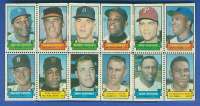
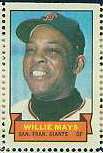
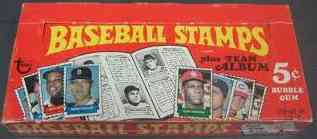
1969 Topps Stamps
Checklist & Values
Following stints as inserts in 1961 and 1962,
stamps finally arrived with their own issue in 1969 !
A nickel for a 12-stamp strip plus a mini album !!!
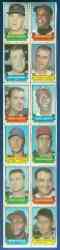
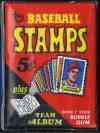 The 1969 Topps Stamps set contained (240) 1x1-7/16 inch unnumbered stamps
with player's photo and name,team & position inside a colored banner.
The stamps were released in both horizontal (2 rows of 6) & vertical (2 columns of 6).
1969 Topps Stamps are often confused with Topps' 1974 issue.
The 1974 Stamps have ovals rather than banners at bottom and
came only in horizontal 12-stamp panels.
The 1969 Topps Stamps set contained (240) 1x1-7/16 inch unnumbered stamps
with player's photo and name,team & position inside a colored banner.
The stamps were released in both horizontal (2 rows of 6) & vertical (2 columns of 6).
1969 Topps Stamps are often confused with Topps' 1974 issue.
The 1974 Stamps have ovals rather than banners at bottom and
came only in horizontal 12-stamp panels.
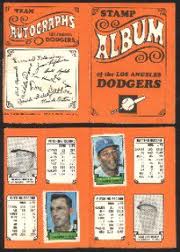 To store the stamps, Topps issued a set of 24 mini albums,
one for each team. The booklets were the same size as a baseball card
and held a complete 10-stamp team set.
More fun for kids, the back cover had facsimile autographs of
all the players in the team set. The design is nearly identical to the
Topps 1969 football 4-in-1 stamp booklets.
To store the stamps, Topps issued a set of 24 mini albums,
one for each team. The booklets were the same size as a baseball card
and held a complete 10-stamp team set.
More fun for kids, the back cover had facsimile autographs of
all the players in the team set. The design is nearly identical to the
Topps 1969 football 4-in-1 stamp booklets.
The 1969 Topps Stamps set is packed with stars like Pete Rose and
tons of Hall-of-Famers including MICKEY MANTLE, Willie Mays, Roberto Clemente
& many more !!!
Click for complete
1969 Topps Baseball Stamps checklist and prices
Note: You may be on that page right now.
For similar Topps issues - Click for complete:
1961 Topps Baseball Stamps checklist and prices
1962 Topps Baseball Stamps checklist and prices
1974 Topps Baseball Stamps checklist and prices
|
1960 Topps Baseball Cards
Checklist & Values
1960's top rookie was Red Sox great Hall-of-Famer Carl Yastrzemski.
Another Hall-of-Famer was pitcher Jim Kaat. Kaat had an incredible
baseball career. Check him out on Wiki and you'll also see why he
gets my vote as the greatest golfer of all-time.
Another rookie card is Hall-of-Famer Willie McCovey with the Giants
and then Frank Howard who was a GIANT (of a man, he was huge).
Such a great crop that future .363 hitting Batting Champ Tommy Davis
barely makes this list.
As was normal back then, the 1960 Topps baseball card set was released
in series and ended up with the usual very scarce high #s. Making it
even more interesting, like their 1959 issue, Topps again put their
special All-Star subset, stuffed with Hall-of-Famers like Mantle &
Mays, in the very scarce high# series.
Two last things and I'll let you go.
Cards #375 thru #440 came in (2) variations. The more common
gray-backs and the somewhat scarcer white-backs. Cards #507
thru #572 were quite scarce high #s.
1960 Fleer Baseball Greats checklist, values and prices.
1960 Leaf Baseball checklist, values and prices.
1960 Nu-Card Hi-Lites checklist, values and prices.
1959 Topps Baseball card checklist, values and prices.
1960 Topps Baseball card checklist, values and prices.
(You may be on that page now)
1961 Topps Baseball card checklist, values and prices.
|
Baseball card collecting terms (part A)
Airbrushing is the art of touching up a photo prior to the card being printed.
It was generally done to remove imperfections or update or hide a players
jersey/cap logo. Because of advancements in print technology and computers this is
no longer needed.
All-Star card (AS) usually a subset card picturing a player who participated in the
previous season’s all-star game. Topps created these in their 1958 High Number
issue and has continued the practice fairly regularly to date. Such cards
are usually designated in price guides with the abbreviation of AS.
Assorted A general mix of cards often containing many duplicates.
Auction items are sold to the highest bidder. Auctions used to be live
or thru the mail/phone but today most auctions are online.
Auction Catalog lists the rules and descriptions and often images
of the items in an auction.
Authentication verification that an item (card, autograph) is genuine. Most "game-used"
material inserts have a written declaration of authenticity on the reverse.
Authorized Issue card or memorabilia item that has been properly licensed. If
the item is of a player, his written permission must be given in order for it to be considered authorized.