1970 Topps FB #242 Jerry Smith (Redskins)
The most accomplished gay NFL player, passed away from AIDS in 1986. When he retired he held NFL record for most TDs by tight end.| Grade | NM/MINT to MINT |
|---|---|
| Book Value | n/a |
| Our Price |
$ 9.95
Add to cart
|




Please wander around the website for more info, prices, values & images
on vintage baseball, football, basketball, hockey, sport and non-sports cards.
1971 Kellogg's FootballThe 1971 Kellogg's set contained (60) cards.Click for complete 1971 Kellogg's Football (You may be on that page now) |
1965 Philadelphia Football |
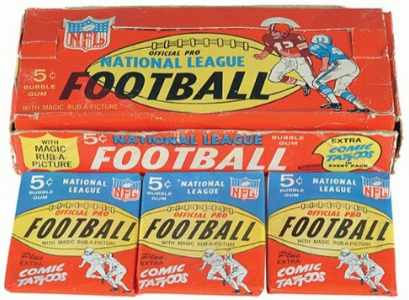 1965 was the 2nd year for Philadelphia Gum creating football cards.
Once again, their set had (198) cards, (14) from each team, featuring the rookie cards of
Hall-of-Famers Paul Warfield, Mel Renfro, Dick LeBeau, Carl Eller, Paul Krause and Charley Taylor.
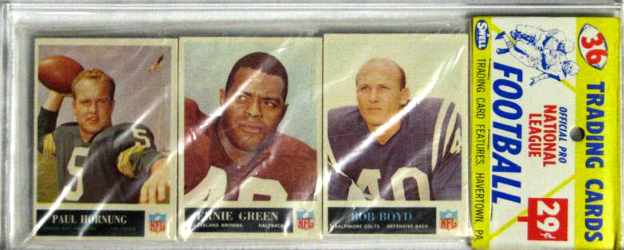
1965 Philadelphia cards came in a variety of packages: nickel wax packs, ten-cent cello packs and 29-cent rack packs.
1965 was the 2nd year for Philadelphia Gum creating football cards.
Once again, their set had (198) cards, (14) from each team, featuring the rookie cards of
Hall-of-Famers Paul Warfield, Mel Renfro, Dick LeBeau, Carl Eller, Paul Krause and Charley Taylor.
1965 Philadelphia cards came in a variety of packages: nickel wax packs, ten-cent cello packs and 29-cent rack packs.
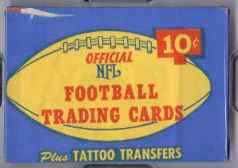 Making this set a bit special was that for the first time in football card history, the NFL logo appeared on the front
of a card. The logo was Philadelphia Gum Company's way of sticking it to Topps as Philadelphia had the exclusive
to produce NFL cards while Topps was left to printing cards of the then 'lesser' AFL teams and players.
Making this set a bit special was that for the first time in football card history, the NFL logo appeared on the front
of a card. The logo was Philadelphia Gum Company's way of sticking it to Topps as Philadelphia had the exclusive
to produce NFL cards while Topps was left to printing cards of the then 'lesser' AFL teams and players.
1969 Topps Football Four-in-One |
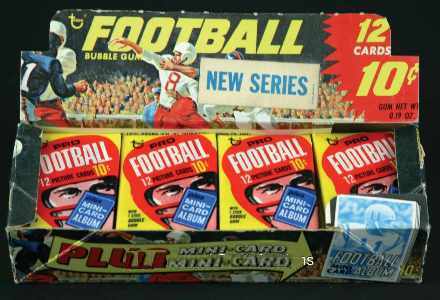 Thru the late 1960's, early 1970's, Topps continued to try new
things as test issues and inserts. 1969 was no different and
along came the 1969 Topps Football Four-in-Ones. Each card was a
perforated panel of (4) mini-cards. Special mini-card albums were
also issued as inserts to hold the mini-cards. Each album had room
for a complete team set of (10) mini-cards.
Thru the late 1960's, early 1970's, Topps continued to try new
things as test issues and inserts. 1969 was no different and
along came the 1969 Topps Football Four-in-Ones. Each card was a
perforated panel of (4) mini-cards. Special mini-card albums were
also issued as inserts to hold the mini-cards. Each album had room
for a complete team set of (10) mini-cards. 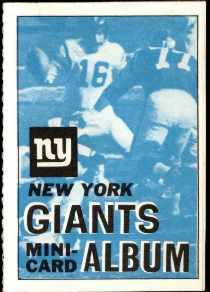 There was one variation in which print color and background on
Bill Triplett's and Charlie Johnson's mini-cards varied.
Interestingly, a few of the players on these mini-cards never
appeared on their own regular card .
There was one variation in which print color and background on
Bill Triplett's and Charlie Johnson's mini-cards varied.
Interestingly, a few of the players on these mini-cards never
appeared on their own regular card . 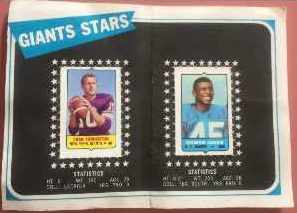
Starting approximately in 1886, sportscards, mostly baseball cards, were often included with tobacco products, for promotional purposes and also because the card reinforced the packaging and protected cigarettes from damage. These sports cards are referred to as tobacco cards in the baseball card hobby. Over the next few years many different companies produced baseball cards. Tobacco cards soon started to disappear as the American Tobacco Company tried to develop a monopoly by buying out other companies.
They were reintroduced in the 1900s, as American Tobacco came under pressure from antitrust action and Turkish competition. The most famous and most expensive, baseball card is the rare T206 Honus Wagner. The card exists in very limited quantities compared to others of its type because Wagner forced the card to be removed from printing. It is widely (and incorrectly) believed that Wagner did so because he refused to promote tobacco, but the true explanation lies in a dispute over compensation.
Soon other companies also began producing baseball and football cards. Sports magazines such as The Sporting News were early entries to the market. Candy manufacturers soon joined the fray and reflected a shift toward a younger target audience for cards. Caramel companies were particularly active and baseball cards were one of the first prizes to be included in Cracker Jacks. World War I soon suppressed baseball card production.
