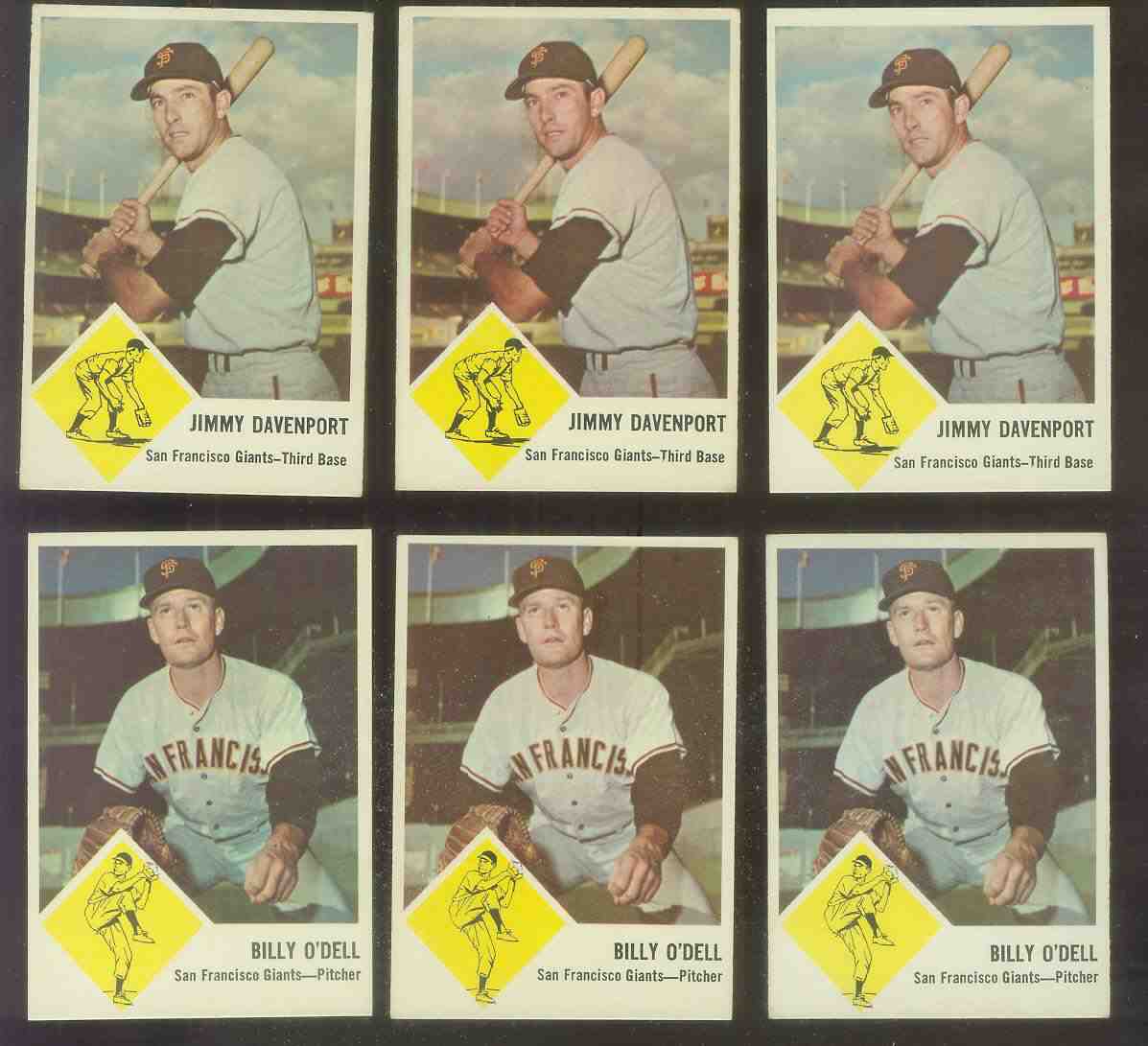
1963 Fleer #65 Jim Davenport (Giants)

Grade
NM/MINT
Book Value
$ 15
Our Price
$ 27.50
Add to cart

1963 Fleer #65 Jim Davenport (Giants)  cards value
Baseball
Below are short bits & pieces on sportscard & baseball trading card collecting.
Please wander around the website for more info, prices, values & images
on vintage baseball, football, basketball, hockey, sport and non-sports cards.

1933-1934/1941 Skybirds (R137-Goudey)

Topps took advantage of the popularity of the TV series and movies featuring the legendary frontiersman Davy Crockett with the release of their 1956 Topps Davy Crockett cards. The 80-card set with their vibrant color art, featured scenes from the TV show and Davy Crockett's life. Moments like Crockett's battles, encounters with Indians, and his famous coonskin cap are captured. Set had (2) series. Thge first 40 were "Davy Crockett, King of the Wild Frontier" with the last (40) "Davy Crockett and the River Pirates." Card backs offered descriptions of the images on front.
Click for complete 1933-1934/1941 Skybirds (R137-Goudey)
Note: You may be on that page right now.

Baseball

1960 Topps Baseball Cards
Checklist & Values


1960's top rookie was Red Sox great Hall-of-Famer Carl Yastrzemski. Another Hall-of-Famer was pitcher Jim Kaat. Kaat had an incredible baseball career. Check him out on Wiki and you'll also see why he gets my vote as the greatest golfer of all-time.

Another rookie card is Hall-of-Famer Willie McCovey with the Giants and then Frank Howard who was a GIANT (of a man, he was huge). Such a great crop that future .363 hitting Batting Champ Tommy Davis barely makes this list.

As was normal back then, the 1960 Topps baseball card set was released in series and ended up with the usual very scarce high #s. Making it even more interesting, like their 1959 issue, Topps again put their special All-Star subset, stuffed with Hall-of-Famers like Mantle & Mays, in the very scarce high# series.

Two last things and I'll let you go.
Cards #375 thru #440 came in (2) variations. The more common gray-backs and the somewhat scarcer white-backs. Cards #507 thru #572 were quite scarce high #s.

Other issues you may be interested in:
1960 Fleer Baseball Greats checklist, values and prices.
1960 Leaf Baseball checklist, values and prices.
1960 Nu-Card Hi-Lites checklist, values and prices.

1959 Topps Baseball card checklist, values and prices.
1960 Topps Baseball card checklist, values and prices.
(You may be on that page now)
1961 Topps Baseball card checklist, values and prices.


Baseball
Baseball card collecting terms (part C)

Cabinet Card Were oversized trading cards featuring paintings issued mostly 1910-1915.

Card Show is a gathering of dealers & collectors looking to buy/sell/trade sports cards and memorabilia.

Card Stock is the material a card is printed on. Usually paper-based, today companies play with the card stock and sometimes it appears to be wood or leather or see-thru acrylic ...

Cello Pack is a card pack whose wrapper is see-thru plastic. Usually the top & bottom cards are seen. Unopened cello packs showing major stars and rookies sell for heavy premiums.

Centering is the balance of the borders: top/bottom & left/right. On perfectly-centered cards, top/bottom borders match as do the left/right borders. Centering is presented as a set of numbers & directions and often included with the grade. Perfectly-centered is "50/50 t/b" AND "50/50 l/r". As centering gets worse, one number increases and the other decreases. For example: 90/10 t/b is considered extremely off-center top to bottom. The numbers add up to 100 (50/50, 60/40, 90/10 ...).

Certificate Of Authenticity (COA) A document used to verify legitimacy of a collectible. NOTE: Keep in mind that COA's are easier to fake then autographs.

Common A card of a non-star player is considered a "Common" as opposed to cards of a star players or specialty/subset cards such as league leaders, teams cards, World Series cards...

Condition (Grade) Centering, corner wear, photo clarity, edges, creases, print flaws ... all combine to determine a card's condition or grade. Along with rarity/scarcity it is the major factor in a card's value.

Crease Defect usually caused by bending the card. Hard to see, or not, a crease lowers the card's grade (VG or lower) and greatly diminishes it's value.

Go back to the Goto top of Vintage Cards
© 1995-2026 www.Baseball-Cards.com / Joseph Juhasz ... All Rights Reserved