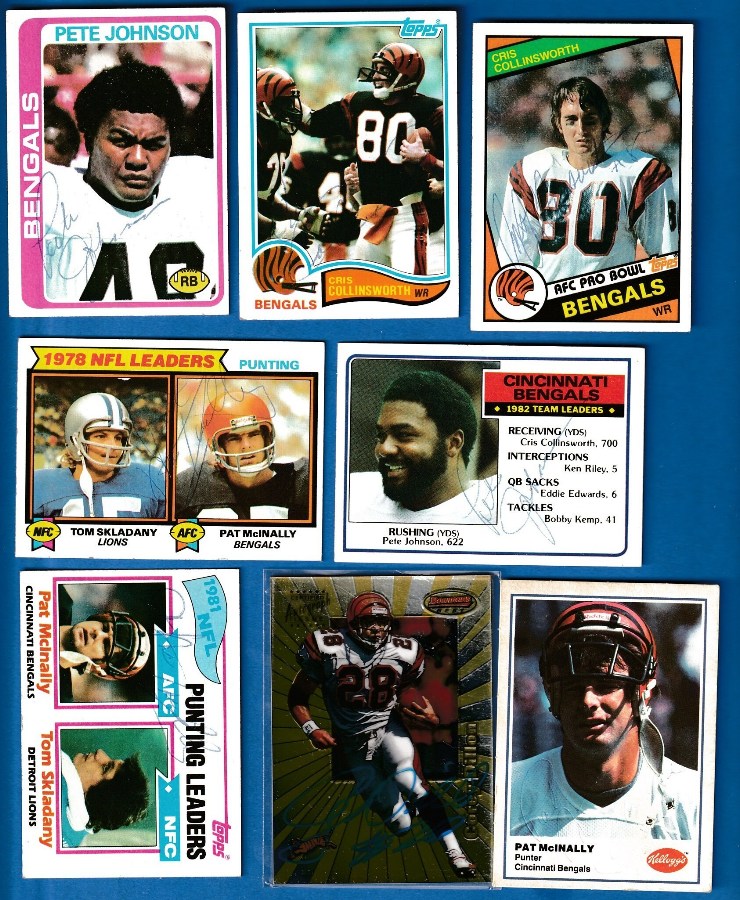
Cincinatti BENGALS - Team Lot of (7) AUTOGRAPHED cards
1978 thru 1984. All Cris Collinsworth,Pete McInally & Pete Johnson. 1983 Bengals leaders picturing/signed Pete Johnson (not pictured).| Grade | EX/MINT to NM/MINT |
|---|---|
| Book Value | n/a |
| Our Price |
$ 19.95
Add to cart
|



Please wander around the website for more info, prices, values & images
on vintage baseball, football, basketball, hockey, sport and non-sports cards.
1960 Topps Baseball Cards |
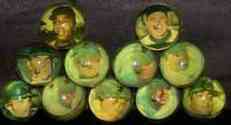
1970 Chemtoy Superballs |
 The 285 player set with 12 per team except Twins, White Sox and A's with 11.
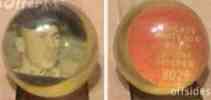
Each "Superball" has the player's photo inside with name,
team, position and Chemtoy inventory number on back.
The 285 player set with 12 per team except Twins, White Sox and A's with 11.
Each "Superball" has the player's photo inside with name,
team, position and Chemtoy inventory number on back.

Cabinet Card Were oversized trading cards featuring paintings issued mostly 1910-1915.
Card Show is a gathering of dealers & collectors looking to buy/sell/trade sports cards and memorabilia.
Card Stock is the material a card is printed on. Usually paper-based, today companies play with the card stock and sometimes it appears to be wood or leather or see-thru acrylic ...
Cello Pack is a card pack whose wrapper is see-thru plastic. Usually the top & bottom cards are seen. Unopened cello packs showing major stars and rookies sell for heavy premiums.
Centering is the balance of the borders: top/bottom & left/right. On perfectly-centered cards, top/bottom borders match as do the left/right borders. Centering is presented as a set of numbers & directions and often included with the grade. Perfectly-centered is "50/50 t/b" AND "50/50 l/r". As centering gets worse, one number increases and the other decreases. For example: 90/10 t/b is considered extremely off-center top to bottom. The numbers add up to 100 (50/50, 60/40, 90/10 ...).
Certificate Of Authenticity (COA) A document used to verify legitimacy of a collectible. NOTE: Keep in mind that COA's are easier to fake then autographs.
Common A card of a non-star player is considered a "Common" as opposed to cards of a star players or specialty/subset cards such as league leaders, teams cards, World Series cards...
Condition (Grade) Centering, corner wear, photo clarity, edges, creases, print flaws ... all combine to determine a card's condition or grade. Along with rarity/scarcity it is the major factor in a card's value.
Crease Defect usually caused by bending the card. Hard to see, or not, a crease lowers the card's grade (VG or lower) and greatly diminishes it's value.
