1961 Topps AUTOGRAPHED #.90 Gerry Staley w/PSA/DNA LOA (White Sox,deceased)
| Grade |
EX+ |
| Book Value |
n/a |
| Our Price |
$ 9.95
Add to cart
|

Below are short bits & pieces on sportscard & baseball trading card collecting.
Please wander around the website for more info, prices, values & images
on vintage baseball, football, basketball, hockey, sport and non-sports cards.
Autographed Gateway Cachets
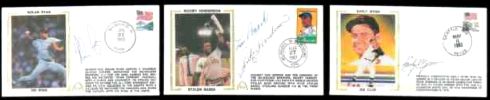
Gateway Stamp Company has provided collectors over 1 MILLION
authenticated certified autographs over the last 30+ years.
Though a "stamp company", Gateway went down a new creative road
combining art, color photographs, historical events & autographs
with their full-color silk cachet envelopes.
WHAT IS A SILK CACHET ?
A "cachet" is a design on an envelope marking an event.
"Silk" refers to the delicate material the art and photography are
printed on after which it's signed by the player and then post-marked by
the Post Office IN THE EVENT'S CITY !!!
WHY POSTMARKS?
A postmark is a great way to mark historical events and the rules
governing postmarks GUARANTEES that NO Gateway issue can EVER be
re-issued protecting their value !!!
Click for complete
Autographed Gateway Cachets info, values & prices.
Note: You may be on that page right now.
|
1960 Topps Baseball Cards Checklist & Values
1960's top rookie was Red Sox great Hall-of-Famer Carl Yastrzemski.
Another Hall-of-Famer was pitcher Jim Kaat. Kaat had an incredible
baseball career. Check him out on Wiki and you'll also see why he
gets my vote as the greatest golfer of all-time.
Another rookie card is Hall-of-Famer Willie McCovey with the Giants
and then Frank Howard who was a GIANT (of a man, he was huge).
Such a great crop that future .363 hitting Batting Champ Tommy Davis
barely makes this list.
As was normal back then, the 1960 Topps baseball card set was released
in series and ended up with the usual very scarce high #s. Making it
even more interesting, like their 1959 issue, Topps again put their
special All-Star subset, stuffed with Hall-of-Famers like Mantle &
Mays, in the very scarce high# series.
Two last things and I'll let you go.
Cards #375 thru #440 came in (2) variations. The more common
gray-backs and the somewhat scarcer white-backs. Cards #507
thru #572 were quite scarce high #s.
Other issues you may be interested in:
1960 Fleer Baseball Greats checklist, values and prices.
1960 Leaf Baseball checklist, values and prices.
1960 Nu-Card Hi-Lites checklist, values and prices.
1959 Topps Baseball card checklist, values and prices.
1960 Topps Baseball card checklist, values and prices.
(You may be on that page now)
1961 Topps Baseball card checklist, values and prices.
|
Protecting and Storing your Card Collection
There are many different ways to protect, organize and store your sports cards.
Soft Sleeves
also called "penny sleeves" are the most basic protection for your cards.
Made of thin plastic, they come in packs of 100 and are very inexpensive.
Top Loads
are rigid plastic holders and a step up in protection over "soft sleeves".
Called top-loads because you place the card thru a thin opening at the top.
They come in many sizes for regular cards upto 8-1/2 x 11 for magazines and
even larger.
Screw-Down Acrylic Holders
These are sometimes used for better, more expensive cards. Small screws hold
two pieces of clear acrylic together. In a variety of sizes and thickness
that not only protect the card but can funciton as a paper weight or display
item.
There are also Single-Screw Screw-Downs that use only 1 screw to seal the holder.
They are easier to use and provide the same type of protectionas regular screwdowns
and they are also much less expensive costing as little as .30 in quantity
while 1 inch or 2 inch acrylic screw-downs can cost upto several dollars.