1975 Topps #450 Willie McCovey (Padres)
| Grade | NM/MINT to MINT |
|---|---|
| Book Value | n/a |
| Our Price |
$ 17.50
Add to cart
|




Please wander around the website for more info, prices, values & images
on vintage baseball, football, basketball, hockey, sport and non-sports cards.
1971 O-Pee-Chee/OPC Baseball Cards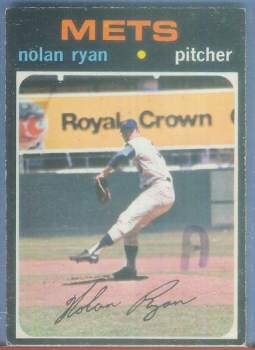
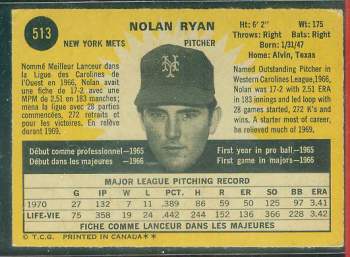
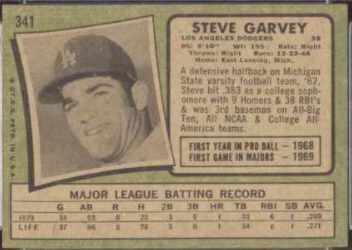 O-Pee-Chee is also called OPC and Topps Canadian.
Most vintage OPC sets were near replicas of their Topps brothers
in the exact same design, with the major difference being the
French & English backs. But in 1971, O-Pee-Chee made
several changes to their set including a complete redesign of
the card backs. OPC also changed over 20 cards including the
creation of the first "Traded" cards along with adding more EXPOS
to the set including #202 and #289.
O-Pee-Chee is also called OPC and Topps Canadian.
Most vintage OPC sets were near replicas of their Topps brothers
in the exact same design, with the major difference being the
French & English backs. But in 1971, O-Pee-Chee made
several changes to their set including a complete redesign of
the card backs. OPC also changed over 20 cards including the
creation of the first "Traded" cards along with adding more EXPOS
to the set including #202 and #289.
1971 OPC's short prints are legendary, at only 5% of Topps' production, making this set very rare even in Canada. Some say 1971 OPC short print high numbers are even scarcer than the very, very scarce 1952 Topps highs, that mostly ended up being dumped deep into the Atlantic ocean.
The Semi-High #'s 524-643 are VERY, VERY costly on eBay and
elsewhere on the internet and the High #'s are INSANE !!!
ROOKIES included Hall-of-Famer Bert Blyleven,
Steve Garvey, Davey Concepcion, Bobby Valentine,
George Foster, Dusty Baker...
1971 Mattel Instant Replay Discs 1971 Topps 1971 Kellogg's
1970 OPC/O-Pee-Chee Baseball
Click for all of our OPC/O-Pee-Chee Baseball issues |
Cabinet Card Were oversized trading cards featuring paintings issued mostly 1910-1915.
Card Show is a gathering of dealers & collectors looking to buy/sell/trade sports cards and memorabilia.
Card Stock is the material a card is printed on. Usually paper-based, today companies play with the card stock and sometimes it appears to be wood or leather or see-thru acrylic ...
Cello Pack is a card pack whose wrapper is see-thru plastic. Usually the top & bottom cards are seen. Unopened cello packs showing major stars and rookies sell for heavy premiums.
Centering is the balance of the borders: top/bottom & left/right. On perfectly-centered cards, top/bottom borders match as do the left/right borders. Centering is presented as a set of numbers & directions and often included with the grade. Perfectly-centered is "50/50 t/b" AND "50/50 l/r". As centering gets worse, one number increases and the other decreases. For example: 90/10 t/b is considered extremely off-center top to bottom. The numbers add up to 100 (50/50, 60/40, 90/10 ...).
Certificate Of Authenticity (COA) A document used to verify legitimacy of a collectible. NOTE: Keep in mind that COA's are easier to fake then autographs.
Common A card of a non-star player is considered a "Common" as opposed to cards of a star players or specialty/subset cards such as league leaders, teams cards, World Series cards...
Condition (Grade) Centering, corner wear, photo clarity, edges, creases, print flaws ... all combine to determine a card's condition or grade. Along with rarity/scarcity it is the major factor in a card's value.
Crease Defect usually caused by bending the card. Hard to see, or not, a crease lowers the card's grade (VG or lower) and greatly diminishes it's value.
