Beatles: 1964 Topps DIARY - Starter Set/Lot of (47/60)
A few lower. A great set! Nearly 80% complete. Colored fronts,backs written like entries in one of the Beatles' diaries.| Grade | Mostly EX |
|---|---|
| Book Value | n/a |
| Our Price |
$ 85
Add to cart
|


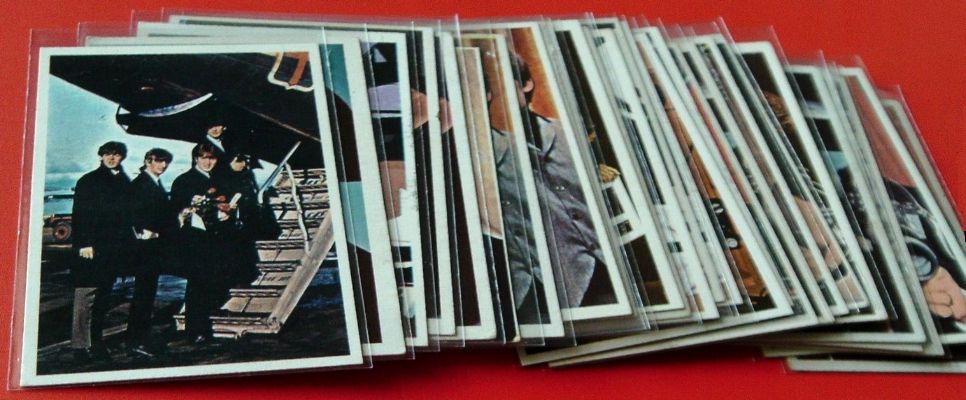

Please wander around the website for more info, prices, values & images
on vintage baseball, football, basketball, hockey, sport and non-sports cards.


1950 Bowman FootballThe 1950 Bowman Football set contained (144) cards.Bowman did not publish football cards in 1949. In an agreement with Leaf Card Company, Bowman allowed Leaf to be the exclusive company to print 1949 cards and in exchange Leaf would leave the card market, leaving Bowman an exclusive on Football cards for a few years till Topps entered the market.
TOP ROOKIES: Y.A. Tittle, Otto Graham, Elroy 'Crazy Legs' Hirsch,
Lou Groza, Tom Fears, Glenn Davis, Joe Perry...
Note: You may be on that page right now. |
1956 Topps Flags of the World |

1938 Horrors of War - Gum Inc.One of the most famous and popular card sets, it began as a 240-card set covering several wars: Chinese/Japanese, Ethiopian and Spanish Civil War. 48 cards were added late on Germany and the beginnings of World War II.The set is extremely popular and prices have increased ten-fold since the early 1990s. |
Cabinet Card Were oversized trading cards featuring paintings issued mostly 1910-1915.
Card Show is a gathering of dealers & collectors looking to buy/sell/trade sports cards and memorabilia.
Card Stock is the material a card is printed on. Usually paper-based, today companies play with the card stock and sometimes it appears to be wood or leather or see-thru acrylic ...
Cello Pack is a card pack whose wrapper is see-thru plastic. Usually the top & bottom cards are seen. Unopened cello packs showing major stars and rookies sell for heavy premiums.
Centering is the balance of the borders: top/bottom & left/right. On perfectly-centered cards, top/bottom borders match as do the left/right borders. Centering is presented as a set of numbers & directions and often included with the grade. Perfectly-centered is "50/50 t/b" AND "50/50 l/r". As centering gets worse, one number increases and the other decreases. For example: 90/10 t/b is considered extremely off-center top to bottom. The numbers add up to 100 (50/50, 60/40, 90/10 ...).
Certificate Of Authenticity (COA) A document used to verify legitimacy of a collectible. NOTE: Keep in mind that COA's are easier to fake then autographs.
Common A card of a non-star player is considered a "Common" as opposed to cards of a star players or specialty/subset cards such as league leaders, teams cards, World Series cards...
Condition (Grade) Centering, corner wear, photo clarity, edges, creases, print flaws ... all combine to determine a card's condition or grade. Along with rarity/scarcity it is the major factor in a card's value.
Crease Defect usually caused by bending the card. Hard to see, or not, a crease lowers the card's grade (VG or lower) and greatly diminishes it's value.
