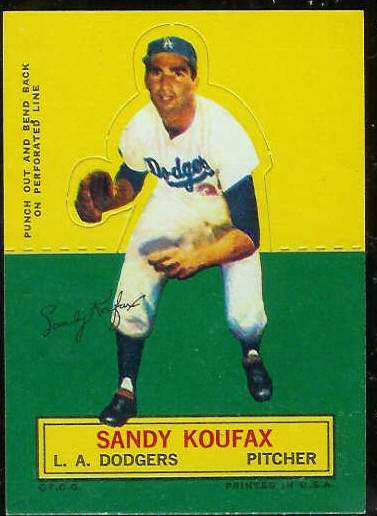
1964 Topps Stand-Ups - Sandy Koufax (Dodgers)
| Grade | NM/MINT to MINT |
|---|---|
| Book Value | $ 200 |
| Our Price |
$ 495
Add to cart
|



Please wander around the website for more info, prices, values & images
on vintage baseball, football, basketball, hockey, sport and non-sports cards.


1975 O-Pee-Chee (OPC) Baseball |

Topps Legendary Vault
From early 1950's on up, Topps has been gathering their rare, unique,
1-of-1 items.
In 1989 they chose Guernsey's Auction House to start unloading
their special rare collectibles. This was such a huge event that
even the auction catalog is a collectible. The auction took place
August 19th and 20th in New York City.
Click to see our current and past
Topps Vault, Proofs & Blank-Backs
They sold everything !!!
Topps work product included mockups, design alternatives,
artwork, photos, negatives, transparencies, flexichromes,
proof sheets, color separations, uncut sheets...
Also: Player's contracts, Canceled checks, Letters,
Unredeemedand redemption prizes, Special Binders of card sets...
Final proceeds of over 3,000 items was around $1.6 million,
a stunning amount in the day. There were (4) additional pages
of non-sport items via mail-only auctions that remained open
until year end. Collector Keith Olbermann attended the auction
and described it to Sports Illustrated, "It's like an archaeological dig."
Topps archive material continued to accumulate after the auction
ending up with another treasure of over 250,000 transparencies,
uncut sheets, color separations, art, photos, slides, proof sheets
& wrappers, canceled checks, contracts and one-of-a-kind
items to sell.
(You may be on that page now) |
Starting approximately in 1886, sportscards, mostly baseball cards, were often included with tobacco products, for promotional purposes and also because the card reinforced the packaging and protected cigarettes from damage. These sports cards are referred to as tobacco cards in the baseball card hobby. Over the next few years many different companies produced baseball cards. Tobacco cards soon started to disappear as the American Tobacco Company tried to develop a monopoly by buying out other companies.
They were reintroduced in the 1900s, as American Tobacco came under pressure from antitrust action and Turkish competition. The most famous and most expensive, baseball card is the rare T206 Honus Wagner. The card exists in very limited quantities compared to others of its type because Wagner forced the card to be removed from printing. It is widely (and incorrectly) believed that Wagner did so because he refused to promote tobacco, but the true explanation lies in a dispute over compensation.
Soon other companies also began producing baseball and football cards. Sports magazines such as The Sporting News were early entries to the market. Candy manufacturers soon joined the fray and reflected a shift toward a younger target audience for cards. Caramel companies were particularly active and baseball cards were one of the first prizes to be included in Cracker Jacks. World War I soon suppressed baseball card production.
