1964 Bazooka Stamps - WILLIE MAYS - COMPLETE 10-Stamp PANEL

With Frank Robinson,Don Zimmer,Bobby Richardson,Larry Jackson,Norm Siebern,Floyd Robinson,Al McBean,Bob Aspromonte & Bill Monbouquette.
Grade
NEAR MINT to NM/MINT
Book Value
n/a
Our Price
$ 295
Add to cart

No image available
Baseball
Below are short bits & pieces on sportscard & baseball trading card collecting.
Please wander around the website for more info, prices, values & images
on vintage baseball, football, basketball, hockey, sport and non-sports cards.

1952 Topps Baseball Cards
Checklist & Values


1952 is often thought of as Topps 1st baseball card set, but it was not.
Topps issued the following baseball card sets prior to their huge 1952 set:
• 1948 Topps Magic Photos
• 1951 Topps Red Backs
• 1951 Topps Blue Backs
• 1951 Topps Connie Mack's All-Stars
• 1951 Topps Major League All-Stars

The 1951 Red & Blue Back issues (52 cards each) were similar to a deck of cards and could be used to play a baseball card game. The sets left out all the game's stars and were not fan favorites keeping Bowman far ahead in the baseball card market.

In response, Topps issued their "BIGGER is BETTER" 1952 Topps set they described as: "GIANT IN BOTH SIZE and NUMBER of CARDS" (407).

Series one cards (#1-80) can be found with black or red backs. The key card in the 1952 Topps set is card #311 MICKEY MANTLE. It is often called Mickey Mantle's Rookie card but it is not. The honor goes to his 1951 Bowman card. The 1952 Topps set also featured my favorite and THE greatest player of all-time, WILLIE MAYS !!! Again, this is sometimes called Willie Mays' Rookie card but it is not. That honor also goes to his 1951 Bowman card.

Another 1952 Topps card of note is card #1 Andy Pafko. Pafko, a fine player, is basically just a "Common card" and should be worth no more than any other "Common" in the 1952 Topps set - But SURPRIZE !!! It's worth TONS more because it's card #1 and absorbed much more damage than most cards from rubber bands and other damage, thus high grade cards are very, very tough to find accounting for the super high values.
BUT --- That should not account for the super high asking prices on lower grade copies. THose prices do not make sense (supply and demand).

The 6th (last) series, starts with #311 Mickey Mantle and ends with #407 Braves Hall-of-Famer Eddie Mathews. These "High Numbers" are significantly scarcer and can almost be called rare. In addition to Mickey Mantle, other star High Numbers included #312 Jackie Robinson and #314 Roy Campanella.

The most common explanation for their scarcity is as follows.
This HUGE set was released in series weeks apart. When it came to the last series the baseball season was winding down and football was starting. Most candy store owners had boxes of baseball cards leftover from earlier in the year so most eliminated their orders for the 6th series of 1952 Topps thus creating the scarcity.

To add interest to the story, it is often said that the unsold 6th series cards (including THOUSANDS of 1952 Topps MICKEY MANTLEs !!!) were disposed of by Topps, dumped offshore into the Atlantic Ocean like most of New York's trash in those days.

Other issues you may be interested in:
1951 Topps BLUE Backs Baseball card checklist, values and prices.
1951 Topps RED Backs Baseball card checklist, values and prices.
1952 Topps Baseball card checklist, values and prices.
(You may be on that page now)
1953 Topps Baseball card checklist, values and prices.
Baseball

1959 Fleer Ted Williams baseball cards


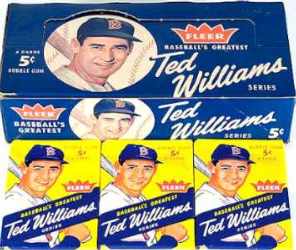
1959 Fleer Ted Williams Box This special 80-card set from the Frank H. Fleer Company honors Ted Williams, "The Splendid Splinter." While other companies vied for Topps' exclusive player rights, Fleer successfully secured Ted Williams, who, nearing the end of his career, remained one of the best and most popular players.
"Teddy Ballgame" had a remarkable career, and the set captures many of his highlights, including his two Triple Crowns. He is still the last hitter to reach the .400 mark! Several popular cards feature Ted with other stars, including Babe Ruth, Jimmie Foxx, football star Jim Thorpe, and golfer Sam Snead.

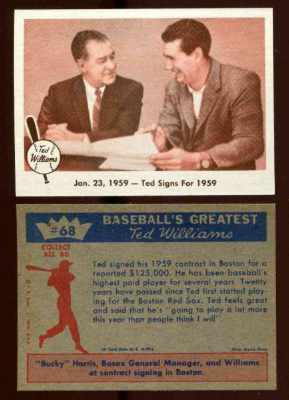
1959 Fleer Ted Williams Box Of particular note is Card #68, "Ted Signs for 1959," which pictures him signing his contract. The photo also included Red Sox GM Bucky Harris, who was under one of those exclusive deals with Topps at the time. This led to the card being pulled, making it extremely scarce. Unfortunately, reprints of the card surfaced in the 1970s. This is widely considered the first baseball card to be reprinted/counterfeited. Interestingly, the counterfeits were allowed to remain on the market, so caution is advised when dealing with this card.
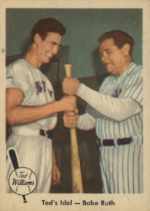
1959 Fleer Ted Williams w/Ruth Cards were sold in both six-card and eight-card wax packs. For some reason, the scarcer 8-card packs contained no gum. 1959 Fleer Ted Williams w/Babe Ruth
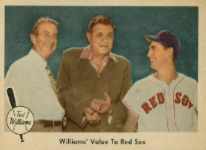
Click for complete 1959 Fleer Ted Williams baseball card set
Note: You may be on that page right now.

Other baseball issues from Fleer:
1960 Fleer Baseball Greats
1961 Fleer Baseball Greats
1963 Fleer Baseball

Baseball
Tobacco Cards

Starting approximately in 1886, sportscards, mostly baseball cards, were often included with tobacco products, for promotional purposes and also because the card reinforced the packaging and protected cigarettes from damage. These sports cards are referred to as tobacco cards in the baseball card hobby. Over the next few years many different companies produced baseball cards. Tobacco cards soon started to disappear as the American Tobacco Company tried to develop a monopoly by buying out other companies.

They were reintroduced in the 1900s, as American Tobacco came under pressure from antitrust action and Turkish competition. The most famous and most expensive, baseball card is the rare T206 Honus Wagner. The card exists in very limited quantities compared to others of its type because Wagner forced the card to be removed from printing. It is widely (and incorrectly) believed that Wagner did so because he refused to promote tobacco, but the true explanation lies in a dispute over compensation.

Soon other companies also began producing baseball and football cards. Sports magazines such as The Sporting News were early entries to the market. Candy manufacturers soon joined the fray and reflected a shift toward a younger target audience for cards. Caramel companies were particularly active and baseball cards were one of the first prizes to be included in Cracker Jacks. World War I soon suppressed baseball card production.

Go back to the Goto top of Vintage Cards
© 1995-2026 www.Baseball-Cards.com / Joseph Juhasz ... All Rights Reserved