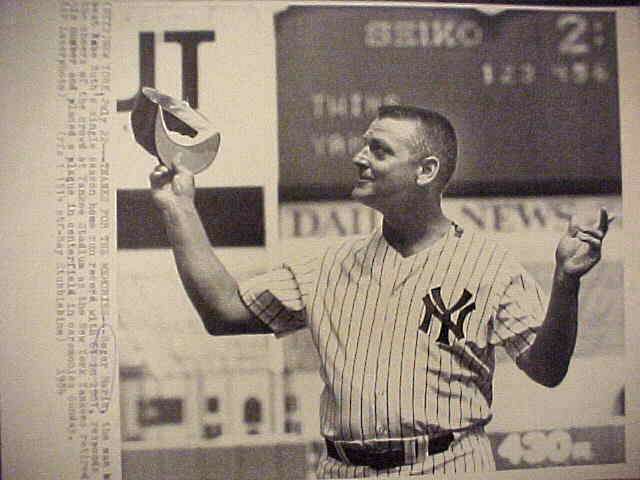
WIREPHOTO: Roger Maris - [07/22/84] 'Thanks For The Memories' (Yankees)
| Book Value | n/a |
|---|---|
| Our Price |
$ 17.95
Add to cart
|



Please wander around the website for more info, prices, values & images
on vintage baseball, football, basketball, hockey, sport and non-sports cards.
Topps Legendary Vault
From early 1950's on up, Topps has been gathering their rare, unique,
1-of-1 items.
In 1989 they chose Guernsey's Auction House to start unloading
their special rare collectibles. This was such a huge event that
even the auction catalog is a collectible. The auction took place
August 19th and 20th in New York City.
Click to see our current and past
Topps Vault, Proofs & Blank-Backs
They sold everything !!!
Topps work product included mockups, design alternatives,
artwork, photos, negatives, transparencies, flexichromes,
proof sheets, color separations, uncut sheets...
Also: Player's contracts, Canceled checks, Letters,
Unredeemedand redemption prizes, Special Binders of card sets...
Final proceeds of over 3,000 items was around $1.6 million,
a stunning amount in the day. There were (4) additional pages
of non-sport items via mail-only auctions that remained open
until year end. Collector Keith Olbermann attended the auction
and described it to Sports Illustrated, "It's like an archaeological dig."
Topps archive material continued to accumulate after the auction
ending up with another treasure of over 250,000 transparencies,
uncut sheets, color separations, art, photos, slides, proof sheets
& wrappers, canceled checks, contracts and one-of-a-kind
items to sell.
(You may be on that page now) |
1977-1979 Sportscaster Baseball Cards
|
O-Pee-Chee (OPC) based in Ontario Canada, is mostly thought of as the Canadian version of Topps but it actually pre-dates Topps by many years.
In 1933, OPC issued their first sports card set, the V304 Hockey cards and is currently in the tens of thousands. Their first baseball set was issued in 1937. It was similar to the 1934 Goudeys and Batter-Ups and the top player was Joe Dimaggio.
O-Pee-Chee created baseball card sets similar to TOpps from 1965 into the 1990's. At first OPC sets were much smaller than Topps and included just the first few series. Fronts & backs were nearly identical but with a small "Printed in Canada" on the back and the card stock was slightly different.
Baseball being much less popular in Canada, OPC print runs of their early years were between 1% and 10% of Topps making them exceedingly scarce !!!
Starting in 1970, Canadian legislation demanded all items produced in Canada
carry both French & English so OPC baseball cards became bilingual with both
languages included.
Other OPC differences include:
1971, OPC even changed the back design to a much more
interesting back and also offered 14 different card photos not in the Topps set.
1972 OPC included a card of Gil Hodges mentioning his death that was
not a part of the Topps set.
1974 OPC did not include any "Washington Nationals" variations.
1977 the card format remained like Topps but almost 1/3 of the OPC set had
different poses/images than Topps.
In late 1970's, OPC card fronts appeared similar to Topps but sometimes
included traded information saying "Now with XXXX". They were able to do
this as the OPC cards were printed much later into the season.
