Roger Clemens - 1995 Sportsflix #51 ARTIST'S PROOF (Red Sox)
| Grade |
NM/MINT |
| Book Value |
$ 22.50 |
| Our Price |
$ 11.95
Add to cart
|


Below are short bits & pieces on sportscard & baseball trading card collecting.
Please wander around the website for more info, prices, values & images
on vintage baseball, football, basketball, hockey, sport and non-sports cards.
1952,1953,1954,1955 Red Man TOBACCO
Checklist & Values
Tobacco cards were instrumental in the start of the baseball card industry
but were pretty much unheard of since 1920. That is until RED MAN TOBACCO
got in the game issuing baseball cards in 1952, 1953, 1954 & 1955.
For just 20 cents you got a pouch of Red Man tobacco and one awesome
3-1/2 x 4 inch baseball card with it's tab (3-1/2 x 3-5/8 without).
Exchange FIFTY tabs and you got one free big league style felt
baseball cap of your favorite team. This made cards with tabs much,
much harder to find and values 2 to 10 times higher.
25 players from each league were selected by "Sporting News" editor
J.G. Taylor Spink. A Player's artwork with different backgrounds
was used year after year. If a player changed teams, new team name
& logo were painted over the old one. To determine the year, just
subtract 1 from the expiration date on back of the card.
The 1954 set had four variations.
Click for complete
1952,1953,1954,1955 Red Man Tobacco cards checklist & prices
Note: You may be on that page.
|
|
1970/1972/1973 Topps Candy Lids
Checklist & Values
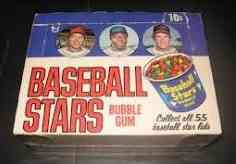
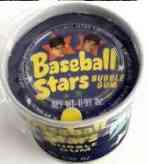
Topps has tried many crazy products, often called "test issues".
Test issues were usually only distributed in limited areas and were difficult
to find. Candy Lids were one of Topps most unusual; little tubs of candy
with player's photos on bottom of the 1 7/8" lids. The 10 cent candy's came 24 to a box.
Sealed tubs can still be found in the $150 to $200 range. Called "Baseball
Stars Bubble Gum", the 1970 Topps Candy Lids set had 24 different
players, while 1973 Topps Candy Lids had 55.
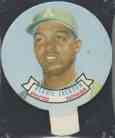
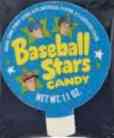
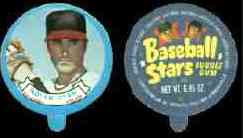 Topps released their first Candy Lids in 1970. The 1970 Topps Candy Lids
are very, very hard to find and had small photos of Tom Seaver,
Carl Yastrzemski and Frank Howard.
Topps released their first Candy Lids in 1970. The 1970 Topps Candy Lids
are very, very hard to find and had small photos of Tom Seaver,
Carl Yastrzemski and Frank Howard.
In 1973 the candy was replaced by gum, the mini photo of Frank Howard was
gone from the top of the lid and team logos were airburshed off the player's
caps. Even the tiny Yaz and Seaver photos logos removed. 1973 Topps Candy
Lids are hard to find, but not nearly as scarce as the 1970's. In 1972
a Topps Candy Lids issue was planned but never released although a few proofs do exist.
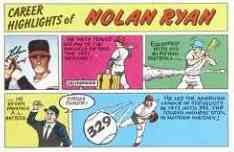 Topps released two other test issue sets in 1973 (1973 Topps Pinups and 1973 Topps Comics).
The 1973 Topps Comics and 1973 Topps Candy Lids shared many photos and again
had no team logos. If thinking "licensing dispute", you are likely right.
Topps received player's union's permission for these test issues, but not
Major League Baseball's. Issues over rights & fees with MLBPA and the player's
union resulted in Topps started shutting down future production of test
issues putting an end to some of their most fun collectibles.
Topps released two other test issue sets in 1973 (1973 Topps Pinups and 1973 Topps Comics).
The 1973 Topps Comics and 1973 Topps Candy Lids shared many photos and again
had no team logos. If thinking "licensing dispute", you are likely right.
Topps received player's union's permission for these test issues, but not
Major League Baseball's. Issues over rights & fees with MLBPA and the player's
union resulted in Topps started shutting down future production of test
issues putting an end to some of their most fun collectibles.
Click for complete
1973 Topps Candy Lids Checklist and Prices
Note: You may be on that page right now.
|
Baseball card collecting terms (part A)
Airbrushing is the art of touching up a photo prior to the card being printed.
It was generally done to remove imperfections or update or hide a players
jersey/cap logo. Because of advancements in print technology and computers this is
no longer needed.
All-Star card (AS) usually a subset card picturing a player who participated in the
previous season’s all-star game. Topps created these in their 1958 High Number
issue and has continued the practice fairly regularly to date. Such cards
are usually designated in price guides with the abbreviation of AS.
Assorted A general mix of cards often containing many duplicates.
Auction items are sold to the highest bidder. Auctions used to be live
or thru the mail/phone but today most auctions are online.
Auction Catalog lists the rules and descriptions and often images
of the items in an auction.
Authentication verification that an item (card, autograph) is genuine. Most "game-used"
material inserts have a written declaration of authenticity on the reverse.
Authorized Issue card or memorabilia item that has been properly licensed. If
the item is of a player, his written permission must be given in order for it to be considered authorized.