Jeff Bagwell - 1991 Upper Deck #755 ROOKIE - Lot of (10) (Astros)
| Grade | NM/MINT |
|---|---|
| Book Value | n/a |
| Our Price |
$ 14.95
Add to cart
|




Please wander around the website for more info, prices, values & images
on vintage baseball, football, basketball, hockey, sport and non-sports cards.
1971 O-Pee-Chee/OPC Baseball Cards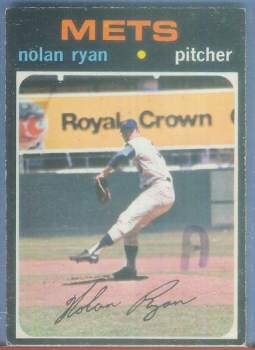
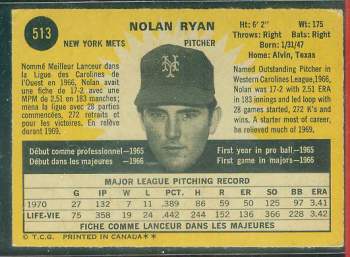
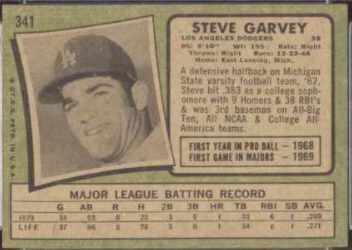 O-Pee-Chee is also called OPC and Topps Canadian.
Most vintage OPC sets were near replicas of their Topps brothers
in the exact same design, with the major difference being the
French & English backs. But in 1971, O-Pee-Chee made
several changes to their set including a complete redesign of
the card backs. OPC also changed over 20 cards including the
creation of the first "Traded" cards along with adding more EXPOS
to the set including #202 and #289.
O-Pee-Chee is also called OPC and Topps Canadian.
Most vintage OPC sets were near replicas of their Topps brothers
in the exact same design, with the major difference being the
French & English backs. But in 1971, O-Pee-Chee made
several changes to their set including a complete redesign of
the card backs. OPC also changed over 20 cards including the
creation of the first "Traded" cards along with adding more EXPOS
to the set including #202 and #289.
1971 OPC's short prints are legendary, at only 5% of Topps' production, making this set very rare even in Canada. Some say 1971 OPC short print high numbers are even scarcer than the very, very scarce 1952 Topps highs, that mostly ended up being dumped deep into the Atlantic ocean.
The Semi-High #'s 524-643 are VERY, VERY costly on eBay and
elsewhere on the internet and the High #'s are INSANE !!!
ROOKIES included Hall-of-Famer Bert Blyleven,
Steve Garvey, Davey Concepcion, Bobby Valentine,
George Foster, Dusty Baker...
1971 Mattel Instant Replay Discs 1971 Topps 1971 Kellogg's
1970 OPC/O-Pee-Chee Baseball
Click for all of our OPC/O-Pee-Chee Baseball issues |
Rickey Henderson Baseball Cards
|
Starting approximately in 1886, sportscards, mostly baseball cards, were often included with tobacco products, for promotional purposes and also because the card reinforced the packaging and protected cigarettes from damage. These sports cards are referred to as tobacco cards in the baseball card hobby. Over the next few years many different companies produced baseball cards. Tobacco cards soon started to disappear as the American Tobacco Company tried to develop a monopoly by buying out other companies.
They were reintroduced in the 1900s, as American Tobacco came under pressure from antitrust action and Turkish competition. The most famous and most expensive, baseball card is the rare T206 Honus Wagner. The card exists in very limited quantities compared to others of its type because Wagner forced the card to be removed from printing. It is widely (and incorrectly) believed that Wagner did so because he refused to promote tobacco, but the true explanation lies in a dispute over compensation.
Soon other companies also began producing baseball and football cards. Sports magazines such as The Sporting News were early entries to the market. Candy manufacturers soon joined the fray and reflected a shift toward a younger target audience for cards. Caramel companies were particularly active and baseball cards were one of the first prizes to be included in Cracker Jacks. World War I soon suppressed baseball card production.
